You're watching a Polymarket contract for a political outcome trade at 32 cents. Your gut says 35 cents is fair. The difference feels small—until you realize that 3-cent edge compounds across 50 trades, or until you see the same contract at 28 cents on Kalshi five minutes later. That's when understanding prediction market odds stops being academic and becomes money.
Prediction market odds represent what traders collectively believe is the probability of an event happening, expressed as a price between 0 and 100 cents (or 0% and 100%). Unlike traditional sports betting where a sportsbook sets the line and profits from the juice, prediction markets are peer-to-peer: your buy price is someone else's sell price. This creates friction—and opportunity.
The critical insight most newcomers miss: the market price is the probability estimate, and discrepancies between markets are where edges live. When Bitcoin futures trade at 71 cents on Polymarket but 68 cents on Kalshi for the same resolution criteria, that's not noise. That's either a data lag or a structural difference in trader composition—both exploitable.
How Do Prediction Market Odds Actually Work?
Prediction market odds are literally probabilities dressed as prices. There's no implied volatility layer, no market maker margin, no closing line adjustment. A contract at 62 cents = the market thinks 62% of traders believe the outcome will resolve YES.
This is radically different from sports betting. A -110 moneyline in sports betting (the standard vig) requires you to risk $110 to win $100. That's an implied probability of 52.4%—but the true probability of the outcome is lower, maybe 51%, and the 1.4% spread is the sportsbook's edge. You're not just betting against an outcome; you're betting against a house that's already won before the game starts.
In prediction markets, there is no house. When you buy a contract at 62 cents, you're betting against every other trader willing to sell at that price. The person on the other side thinks the outcome is less likely than 62%. The market clearing price is where demand and supply balance.
Here's what this means operationally: your edge comes from pricing disagreement, not from beating a mathematical margin. If you think a Fed rate hike is 65% likely but Polymarket prices it at 60%, your edge is 5 percentage points. Buy contracts, hold until resolution, and collect the difference if you're right.
But here's where it gets real: contract design matters. Some Polymarket binary contracts resolve YES/NO. Others use settlement prices (like "Will Bitcoin close above $100K on Dec 31?"). Kalshi uses expiring monthly contracts. The resolution criteria—the exact language that determines YES or NO—is where disputes, delays, and edge-killing ambiguity hide. A contract that seems mispriced might just have murkier resolution language. Check this before size.
Reading Probability Percentages: The Direct Conversion
This part is simple—maybe too simple, which is why traders skip it and leave money on the table.
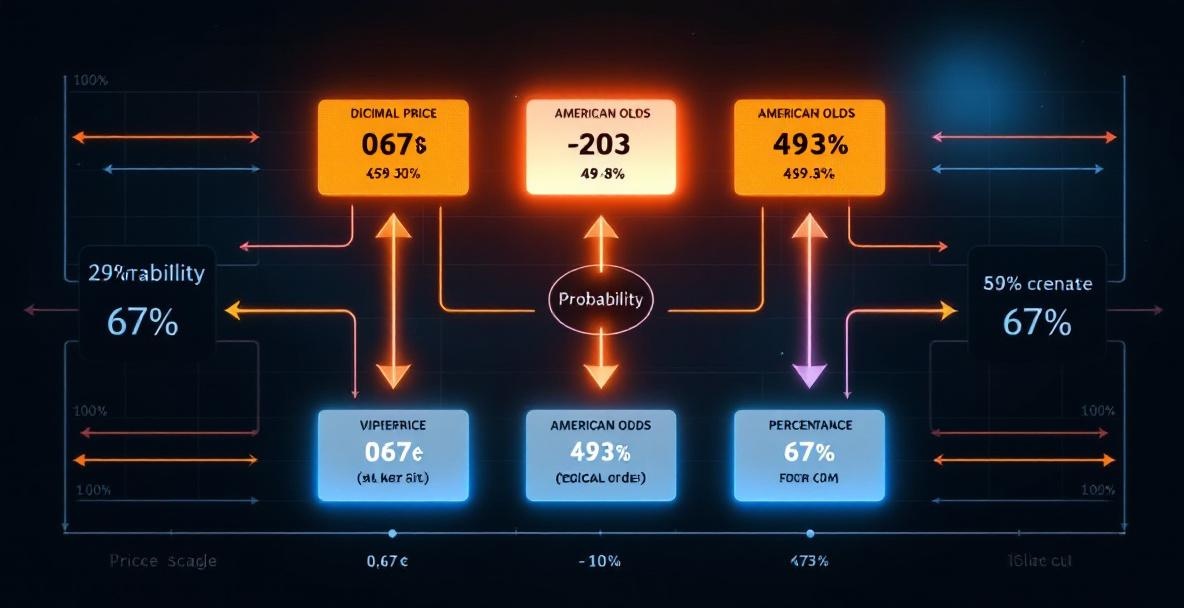
Prediction market price = probability percentage directly. A contract at 28 cents = 28% probability. At 71 cents = 71% probability. No conversion. No formula. Just read the price.
In contrast, traditional odds require conversion. A +150 moneyline in sports betting means: risk $100 to win $150, so your implied probability is (100 / (150 + 100)) = 40%. An -150 moneyline means (150 / (150 + 100)) = 60%. You need to memorize or calculate. Prediction markets eliminated this friction on purpose—transparency is the whole point.
But here's the catch: not all prediction markets use the same display format. Some show decimal odds (1.28, 1.71), others show fractional odds (you probably won't see this, but it exists), and some show cents directly. When you're comparing prices across platforms in real time—say, Polymarket vs. Kalshi vs. a Manifold market—make sure you're looking at the same format.
A practical scenario: You're watching a contract for "Will the US enter a recession by Q2 2025?" On Polymarket it trades at 0.42 (42 cents, 42% probability). On Kalski, the same binary outcome is displayed as a decimal: 1.42. These are not the same. The decimal format (1.42) implies a different stake structure. Polymarket shows you the direct probability as a price; Kalski's decimal format requires you to subtract 1 to get comparable odds. Traders who don't notice this discrepancy blow up comparing markets.
Odds vs. Probability: The Distinction That Makes or Breaks Edges
Most traders conflate odds and probability because, in prediction markets, the market price conflates them. But they're different concepts, and understanding why matters when you're evaluating whether a contract is actually mispriced.
Probability is the likelihood of an outcome (0-100%). You think candidate A has a 55% chance to win the election.
Odds are the ratio at which you'd break even on a bet. If you think something is 55% likely, your fair odds are 55:45, or 1.22 to 1 (you win $122 for every $100 risked). In decimal format (used by prediction markets), that's 1.55. In fractional format (common in UK betting), that's 11:9.
Here's why this distinction matters in practice: when you calculate expected value, you need both the probability and the odds you're getting.
Scenario: A Kalshi contract for "Will Apple's Q1 2025 earnings beat expectations?" trades at 0.63 (63% probability implied). You've run a model and think the true probability is 67%. Your edge is 4 percentage points. But to size your position properly, you need to apply the Kelly Criterion—a formula that tells you what percentage of your bankroll to risk. The Kelly bet size depends on your win probability AND the odds you're getting. If you buy at 0.63 and the contract can only resolve to 0 or 1, your odds are roughly 0.63 / 0.37, or 1.7 to 1. Combine your 67% true probability with those odds, and your edge size becomes concrete. We've covered Kelly in depth; the mechanics matter more than most traders realize.
Another layer: Polymarket and Kalshi use different fee structures. Polymarket takes 2% on profit. Kalshi's fee structure varies by contract type. These fees eat into your odds. A contract where you're risking 100 to win at 0.63 doesn't actually pay 1 dollar on a YES resolution—it pays closer to 0.98 after fees. Your real odds are worse. Professional traders calculate this drag into their edge calculations. Casual traders don't, and it's brutal over volume.
Spotting Cross-Platform Mispricings
Here's where edges actually live: the gaps between platforms.
In early 2024, the same election outcome contract traded as high as 68 cents on Polymarket and as low as 64 cents on Kalshi simultaneously. That 4-cent spread represents free money if you can move capital fast enough. Buy low on Kalshi, sell high on Polymarket, lock in the spread minus fees and slippage. This is called statistical arbitrage, and it's one of the few edges that doesn't require you to have a better model than the market—just faster execution.
The spreads exist because:
- Different fee structures create different breakeven thresholds for traders
- Liquidity varies wildly by platform; one might have $500K in order book depth, the other $2M
- The trader base differs—Polymarket attracts crypto natives; Kalshi attracts traditional finance and retail
- Resolution criteria language differs subtly across platforms for supposedly identical events
Experienced traders run dashboards that pull prices from both platforms in real time and alert them when spreads exceed transaction costs. For a $10K position, a 4-cent spread is $400 gross—minus maybe $100 in combined fees and slippage, leaving $300. On a $10K stake, that's a 3% guaranteed return for holding 10 seconds. Scale that across 20 trades a day and the math changes your year.
The catch: You need capital deployed on both platforms simultaneously, API access (or manual monitoring), and the discipline not to overstay the trade. Most retail traders see the 4-cent spread, get excited, and by the time they buy one side, the spread has collapsed. You need systems, not instinct.
How Mispricing Reveals Itself
Beyond cross-platform spreads, contracts get mispriced when the composition of traders changes.
Consider a Polymarket contract for "Will Elon Musk's net worth exceed $300B by Dec 31, 2025?" It trades at 58 cents for months, reflecting a baseline belief. Then a major news event hits—say, Tesla stock crashes on earnings miss. Within minutes, casual traders panic-sell their positions. The contract drops to 51 cents. But the fundamental probability didn't change that dramatically in 10 minutes; what changed was the temporary composition of buyers and sellers. Professional traders with conviction buy at 51, knowing that over the next weeks, as the panic subsides and Tesla recovers, the price will likely revert toward 58. This is mean reversion, and it's one of the most reliable edges for traders with homework and patience.
Another misprice pattern: lopsided information arrival. A contract for "Will the Fed cut rates in March 2025?" might be fairly priced at 45 cents. Then a major economic report drops at 8:30 AM that only some traders see immediately. For the next 30 minutes, the contract might trade at 52 cents, but in a week, when the whole market has processed the news, it settles at 48 cents. Being that trader who sees the data first, understands it deeply, and acts decisively—that's where prediction market edges come from. It's not exotic math. It's information and speed.
The Math Behind Profitable Odds Evaluation
Let's get concrete with a worked example.
You're evaluating a Kalshi contract: "Will the S&P 500 close above 6,000 on March 31, 2025?" It trades at 0.62 (62 cents, 62% probability implied). You've built a model using historical volatility, current price, and dividend expectations. Your model says 58% probability is fair.
Your edge: 62% market price minus 58% true probability = 4 percentage points. The market thinks the outcome is more likely than you do, so you short (sell) the contract.
But before you size the position, account for:
- Fee drag: Kalshi takes ~2% on winning outcomes. Your effective odds are worse.
- Slippage: You want to sell at 62 cents, but if you're moving $5K in notional value, you might only fill at 61.5 cents average.
- Bankroll management: Apply Kelly Criterion. With 58% true probability and 0.62 selling price, your optimal bet size is roughly ((0.58 0.62) - (0.42 0.38)) / 0.62 ≈ 7.7% of bankroll. Bet too much and volatility kills you; bet too little and the edge barely covers your infrastructure costs.
Most retail traders size intuitively ("that feels like a $1K position") and wonder why their edge doesn't materialize. The math isn't complicated, but it's mandatory.
Why Odds Matter Less Than You Think
Here's a provocation: once you understand how to read prediction market odds, the odds themselves matter less than the process that got them there.
A contract trading at 45 cents tells you the market price, but it doesn't tell you if that price came from careful analysis by 10,000 serious traders or panic-selling by 100 retail traders. It doesn't tell you if the resolution criteria are airtight or ambiguous. It doesn't tell you if the platform's fee structure is eating your edge. The best traders don't stare at the price; they stare at the market composition and the resolution language.
This is why understanding prediction market mechanics (covered in our Polymarket trading guide) matters more than memorizing odds conversion formulas. And it's why comparing outcomes across markets (see our prediction markets vs. sports betting breakdown) reveals structural edges that raw odds don't.
The traders making consistent money aren't the ones who can fastest convert 0.62 to 62%. They're the ones who notice that a contract just went from 10% to 15% implied probability on zero news, or who spot that Kalshi's resolution criteria are clearer than Polymarket's for the same event, or who understand that Bayesian updating means yesterday's price was based on incomplete information.
If you want to compete in prediction markets, spend 20% of your time learning to read odds. Spend 80% learning to spot when the market got them wrong.
The odds are just the scoreboard; the edge is in understanding why the scoreboard moved.